
What Your Money Is Invested In & Where
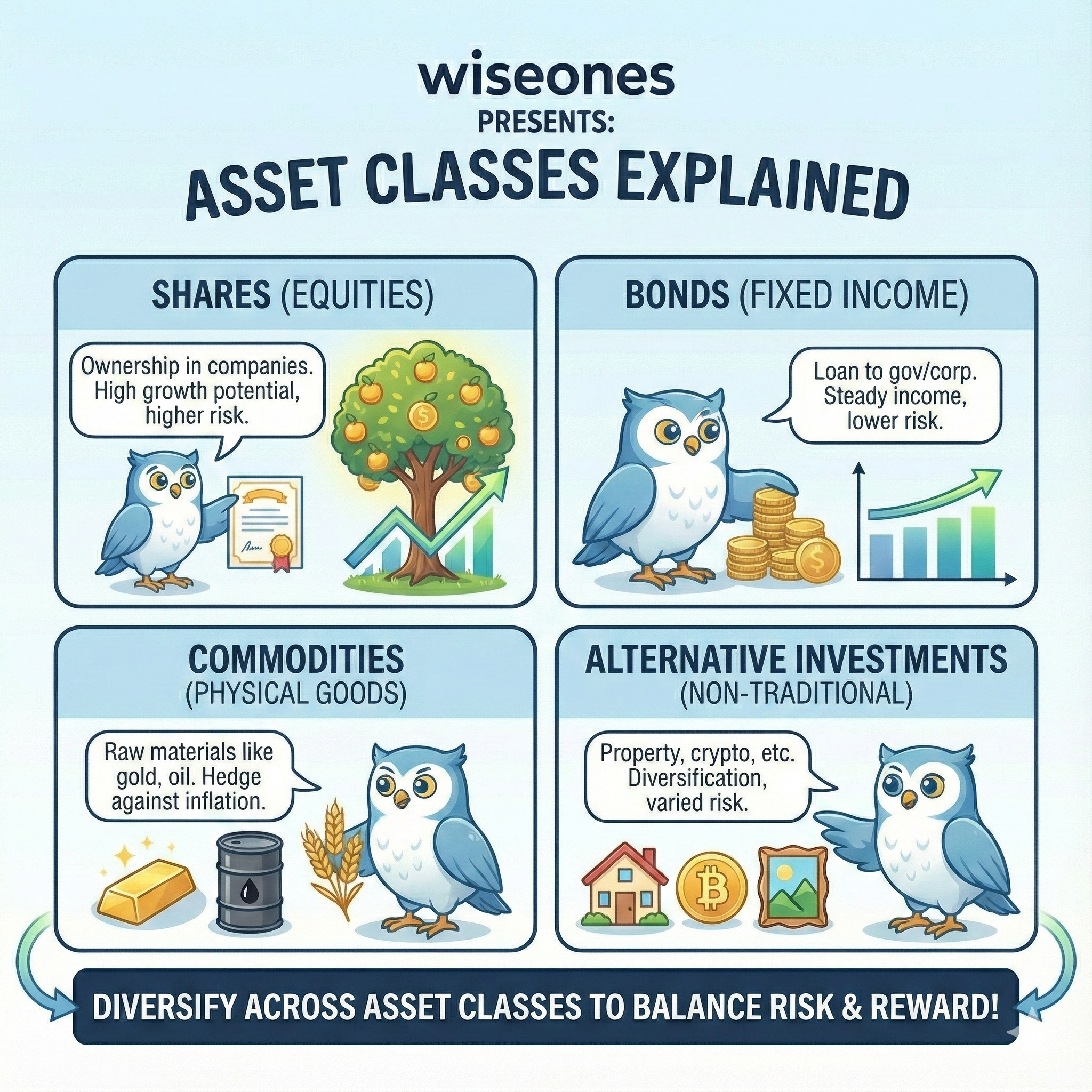
When you invest through a pension, ISA, or investment account, your money is not held as cash. Instead, it is invested across a range of asset classes and geographical regions. Both matter equally. Asset classes explain what you are invested in, while geographical allocation explains where those investments are located and which economies and governments you are exposed to.
Understanding both gives you a far clearer picture of risk, return potential, and diversification.
The Two Dimensions of Investing
Every investment can be viewed through two lenses:
Asset class – shares, bonds, property, commodities, or alternatives
Geography – UK, developed markets, emerging markets, or global exposure
A portfolio invested only in UK or US assets, even if diversified across asset classes, is still exposed to the fortunes of one economy. Equally, a global portfolio invested entirely in shares may be geographically diverse but still high risk.
Shares (Equities)
Shares represent ownership in companies. They are the main engine of long-term growth in most portfolios.
Developed Market Shares
These include companies listed in economically mature countries such as the UK, US, Europe, and Japan.
Characteristics
Well-established legal and regulatory systems
Lower political risk
More stable growth than emerging markets
Emerging Market Shares
These include companies based in faster-growing economies such as China, India, Brazil, and parts of Southeast Asia.
Characteristics
Higher long-term growth potential
Greater volatility
Increased political, currency, and regulatory risk
Emerging market shares are usually held as a smaller allocation within diversified portfolios.
Bonds: Government and Corporate Borrowing
Bonds are loans made by investors to borrowers. These borrowers can be governments or companies, and both issue bonds to raise money.
Government Bonds (Sovereign Debt)
Governments borrow by issuing bonds to fund public spending.
Examples
UK government bonds (gilts)
US Treasuries
European and global government bonds
Characteristics
Generally lower risk of default in developed countries
Sensitive to inflation and interest rate changes
Often used to provide stability rather than growth
Government bonds issued by emerging market countries typically offer higher yields but carry greater risk.
Corporate Bonds (Company Borrowing)
Companies borrow by issuing bonds to fund expansion, investment, or refinancing.
Characteristics
Higher returns than government bonds
Risk varies by company strength
Can be investment-grade (lower risk) or high-yield (higher risk)
Corporate bond funds may invest globally, across both developed and emerging markets.
Property
Property investments usually involve commercial property rather than residential housing.
Geographic Exposure
UK commercial property
Global property funds investing across developed markets
Limited exposure to emerging markets due to liquidity and legal risks
Returns come from
Rental income
Capital appreciation over time
Property can provide diversification but may be difficult to sell quickly during market stress.
Commodities
Commodities are physical raw materials traded on global markets.
Examples
Energy: oil and gas
Metals: gold, copper
Agriculture: wheat, soybeans
Key features
Prices are influenced by global supply and demand
Often priced in US dollars
Can act as a hedge against inflation
Commodity exposure is inherently global and usually makes up a small part of a portfolio.
Alternative Investments
Alternative investments sit outside traditional shares and bonds.
Common Types
Infrastructure (roads, utilities, renewable energy)
Private equity
Absolute return and hedge strategies
Geographic Considerations
Often focused on developed markets for legal stability
Some exposure to emerging markets for higher returns
Less transparency and liquidity than mainstream assets
Alternatives are typically used to diversify returns and reduce reliance on stock markets.
How to Find Out What You’re Invested In
To understand your own investments:
Log in to your provider’s platform
Look for asset allocation and geographical breakdowns
Check fund factsheets
These show both asset class and regional exposure
Review the Key Information Document (KID)
What Is a KID (Key Information Document)?
A Key Information Document (KID) is a short, standardised summary designed to help investors understand an investment before committing.
It explains:
What the investment does
Asset classes and geographical exposure
Risk level (usually on a scale of 1-7)
Potential returns under different scenarios
Costs and charges (these are default and you may be paying a different rate)
KIDs are usually 2-4 pages long and allow easy comparison between different investments.
Bringing It All Together
A well-diversified portfolio considers:
What you’re invested in (asset classes)
Who you’re lending to or owning (governments vs companies)
Where your money is invested (UK, developed, emerging, global)
Understanding these elements helps you judge whether your investments match your time horizon, risk tolerance, and financial objectives and puts you in a far stronger position to ask the right questions of your provider or adviser.