
Here’s a question that sounds simple but isn’t: who is actually making decisions about your money?
It might be you. It might be a wealth manager. It might be someone you’ve never met whose handle you follow on an app. It might be an algorithm. It might be all of the above at different times for different pots.
The point isn’t that some of these are good and some are bad. The point is: do you know which is which, and do you know how to check?
Wiseones view: the problem isn’t that unregulated people give investment ideas. It’s that most consumers have no idea how to tell the difference between a regulated professional, a qualified analyst, a gifted amateur, and someone who got lucky twice and bought a ring light.
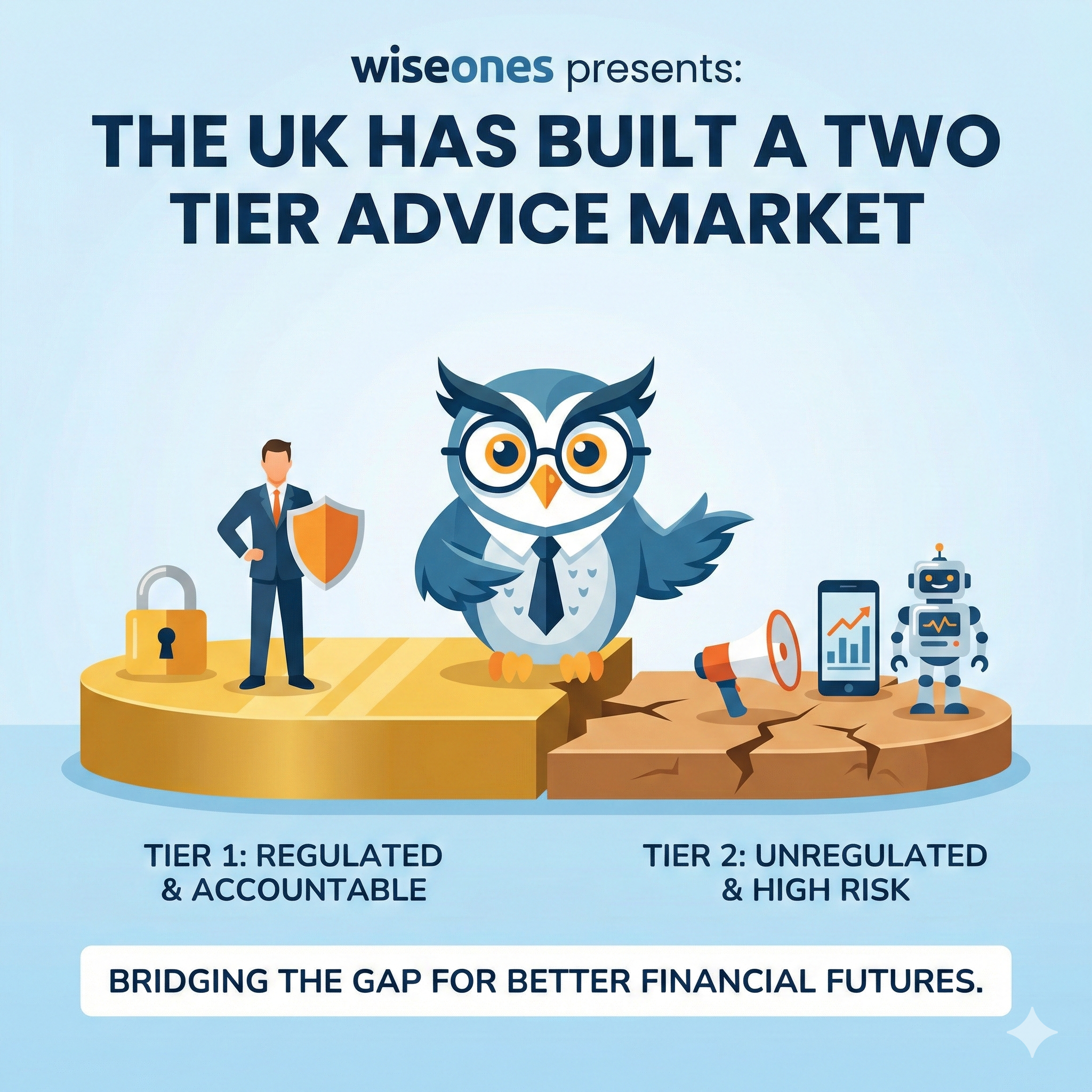
The cast of characters
Let’s meet everyone who might be influencing your investment decisions. Because “financial advice” is just one slice of a much bigger pie.
Investment research houses employ analysts to study markets, sectors, and individual securities. They publish research that fund managers, wealth managers, and sophisticated investors use to make decisions. Names like Morningstar, MSCI, or the research arms of investment banks. Regulated, credentialed, methodical. You’re probably not reading their reports directly, but the people managing your money might be.
Asset managers actually run the funds. They decide what goes into your ISA’s global equity fund or your pension’s bond allocation. Firms like Vanguard, BlackRock, Baillie Gifford, Fundsmith. They’re regulated by the FCA, publish factsheets, and have compliance teams you could wallpaper a building with. When you buy a fund, you’re hiring them to pick investments on your behalf.
Wealth managers build portfolios for individuals. They might use funds from asset managers, or buy individual securities, or both. They’re constructing something tailored (or at least tailored-ish) to your situation. Regulated, qualified, accountable.
Financial advisers recommend specific actions based on your circumstances. Should you consolidate your pensions? Which platform? How much in equities versus bonds? They search the market (if independent) or a panel (if restricted) and document why their recommendation suits you. Regulated, insured, complaints go to the FOS.
Finfluencers share investment content on social media. Some are qualified professionals using a new medium. Some are enthusiastic amateurs sharing their journey. Some are entertainers who’ve discovered that finance content gets clicks. Some are actively trying to pump things they hold. The category is vast, the quality varies wildly, and the disclaimers are often doing a lot of heavy lifting.
Copy trading platforms let you replicate another user’s trades automatically. The “leader” you’re copying might be a professional. Might be someone who got lucky. Might be taking risks you’d never knowingly take. The platform is regulated. The person you’re copying? Not necessarily.
All of these people and institutions can influence what ends up in your portfolio. Only some of them are accountable to you if it goes wrong.
The due diligence problem
Here’s where it gets awkward. If you wanted to check someone’s credentials before letting them influence your investments, how would you actually do it?
For regulated professionals, it’s not that hard. The FCA register exists. You can search a firm or individual, see what they’re authorised to do, check their permissions. Advisers have qualifications you can verify. Wealth managers have regulatory status. It’s not exactly user-friendly, but the information is there.
For asset managers, you can read the fund factsheet, check the manager’s track record, see the charges, understand the strategy. Again, not always thrilling reading, but it exists.
For finfluencers and copy traders? Good luck.
There’s no register. No standardised credentials. No way to verify claims about past performance. No requirement to disclose conflicts. The “leader” you’re copying might show you a screenshot of their gains. They’re probably not showing you the screenshot from the month before.
“But they have millions of followers!” Sure. So did some people who turned out to be running Ponzi schemes. Follower count measures reach, not competence.
The asymmetry is striking. We’ve built extensive verification systems for one part of the market and almost nothing for another, even though both are doing functionally similar things: influencing where your money goes.
What would “simpler regulation” actually look like?
Here’s the thing: the answer isn’t “ban finfluencers” or “regulate TikTok into oblivion.” That ship has sailed, and honestly, some of these creators are doing genuine good, reaching people who’d never engage with traditional finance.
The answer is making it possible to tell the difference.
Imagine a world where:
1. Anyone giving investment content could voluntarily register. Not full FCA authorisation. Something lighter. A public register that says: here are my qualifications (if any), here’s my track record methodology, here’s how I’m compensated, here are my conflicts. Verified by a third party. Searchable by consumers.
The finfluencer who’s actually a qualified analyst? They’d want to be on this. It’s a competitive advantage. The one who’s winging it with other people’s money? They’d skip it. And that tells you something.
2. Copy trading “leaders” had minimum disclosure requirements. If people are replicating your trades, you’re functionally a portfolio manager. Require: verified track record (not screenshots), risk metrics, maximum drawdown history, disclosure of what percentage of your own money is in the strategy. Doesn’t need to be full wealth manager regulation. But it needs to be something.
3. The FCA register was actually usable. Right now, checking someone’s regulatory status requires knowing the register exists, navigating a clunky interface, and understanding what the permissions mean. Put a simple verification badge system in place. Scannable. Mobile-friendly. “This person is FCA-authorised to do X.” Make it as easy to check as a blue tick.
4. “Research” versus “advice” versus “entertainment” had visible labels. A lot of finfluencer content technically isn’t advice. It’s “general information” or “my personal opinion” or “not a recommendation.” The disclaimers exist, but they’re buried. Require prominent labelling at the point of consumption. Not legal boilerplate. A simple, standardised indicator of what category this content falls into.
The spectrum, not the binary
The old framing was: regulated advice good, everything else bad.
That was never quite right, and it’s definitely not right now.
The reality is a spectrum:
Highly regulated, fully accountable: Advisers giving personal recommendations, wealth managers running your portfolio, asset managers running funds. If they get it wrong, there are consequences.
Regulated but limited: Platforms that offer copy trading (the platform is regulated, the person you’re copying isn’t). Robo-advisers that ask you ten questions and allocate accordingly.
Unregulated but potentially valuable: Qualified professionals sharing insights on social media. Research that doesn’t constitute advice. Educational content that helps people understand markets.
Unregulated and potentially dangerous: Pump-and-dump schemes. Fake gurus. Unlicensed “mentors” selling courses on how to replicate their (unverified) success.
The goal isn’t to push everyone into the first category. That’s not realistic, and it would cut off access to genuinely useful content. The goal is to make it possible for consumers to know where on the spectrum they are.
Right now, that’s harder than it should be.
Wiseones bottom line: make the invisible visible
So who picks your investments?
Could be a professional with decades of experience and regulatory accountability. Could be someone who started posting six months ago and has a gift for confident delivery. Could be an algorithm optimising for engagement rather than returns. Could be you, making decisions based on a combination of all of the above.
None of these are automatically wrong. But you should be able to know.
The due diligence tools exist for regulated professionals. They barely exist for everyone else. And “everyone else” is increasingly where people get their investment ideas.
We don’t need to ban the unregulated space. We need to make it legible. Create voluntary registers. Require minimum disclosures for copy trading. Make regulatory status easy to check. Label content clearly.
Let the qualified professionals stand out. Let the talented amateurs build credibility. Let the chancers be visibly uncheckable.
Because the question isn’t whether you should listen to a finfluencer or a wealth manager. The question is whether you can tell which is which, and what that difference actually means for your money.
Right now, for most people, the honest answer is: not really.
That’s fixable. And it doesn’t require making advice more expensive or social media less accessible. It just requires making the invisible visible.