
If you’ve ever Googled “should I invest passively or actively,” you’ve probably been served a nice clean answer: passive is cheap, active is expensive, passive wins. End of debate.
Except it’s not that simple. Not even close.
The passive vs active conversation is one of the most misunderstood topics in investing, and the confusion isn’t just among new investors. Plenty of experienced ones get tripped up too. So let’s unpack it properly, because the words “passive” and “active” don’t mean what most people think they mean.
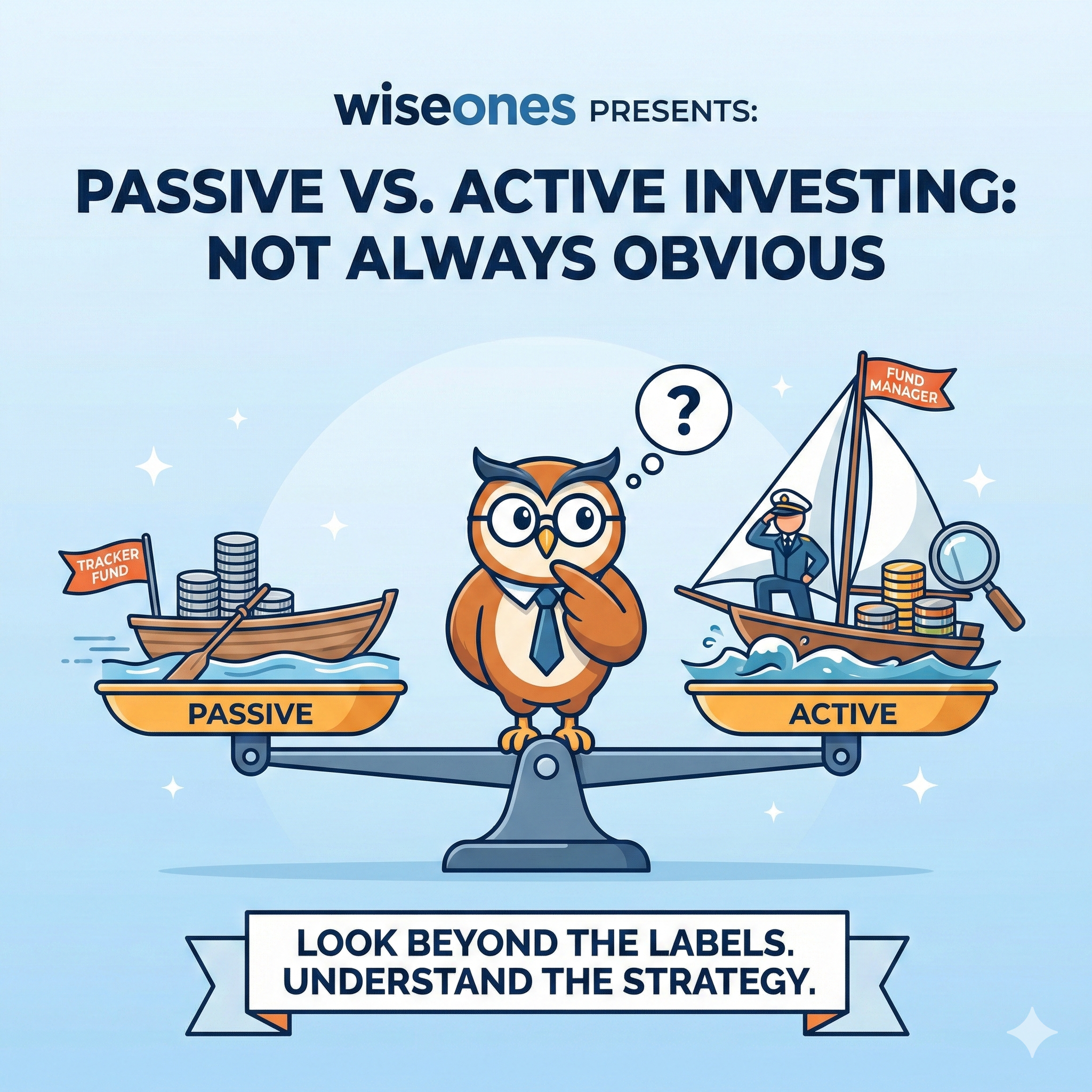
First things first: what is a tracker fund?
This is where it all starts. A tracker fund, sometimes called an index fund, does exactly what the name suggests: it tracks an index.
Pick an index. The FTSE 100, the S&P 500, the MSCI World. A tracker fund buys the same shares, in the same proportions, as whatever index it’s following. Nobody is sitting in an office deciding which stocks to buy or sell. There’s no fund manager having a hunch about Tesla or dumping Unilever because they don’t like the new CEO. The fund just mirrors the index, mechanically, automatically.
That’s why they’re cheap. There’s no expensive human making decisions. You’re essentially buying “the market” and accepting whatever return it gives you; good, bad, or sideways.
A tracker is, by definition, a passive fund. It is passively managed. No one is at the wheel.
But here’s the bit people get wrong: a passive investment strategy is not the same thing as holding a tracker fund.
What does “passive” actually mean in an investment strategy?
When your adviser or your platform describes your investment as “passive,” they’re telling you something about the underlying funds your money is invested in, not about whether someone is managing the overall portfolio.
A passive strategy means the funds held within your investment are passively managed. They track indices. No stock-picking fund managers. No one trying to beat the market.
But, and this is the important part, the portfolio itself can absolutely be actively managed at the allocation level.
Think of it like this: you might hold six or seven different passive funds inside your portfolio. One tracks UK equities, one tracks US equities, one tracks emerging markets, one tracks government bonds, and so on. Each of those individual funds is passive. Nobody’s picking stocks within them.
But someone is deciding how much of your money goes into each one. And that someone can change those proportions whenever they think it’s appropriate. Maybe they reduce your exposure to US equities because valuations look stretched. Maybe they increase your allocation to bonds because the economic outlook has shifted.
The funds are passive. The management of the portfolio is active. That’s a managed passive strategy, and it’s fundamentally different from just buying a single tracker and forgetting about it.
Can a passive strategy include active funds?
Yes. And this catches people off guard.
A portfolio branded as “passive” can, and often does, hold a proportion of actively managed funds. This might sound contradictory, but it’s about the overall philosophy. The core of the portfolio tracks indices. The majority of the holdings are passive. But a manager might add a small allocation to an actively managed fund in a specific area, perhaps an absolute return fund, or a specialist sector where passive options are limited or where active management has a demonstrable edge.
The label “passive” describes the dominant approach, not an absolute rule. It means you’re not paying for wall-to-wall active management across the whole portfolio.
So what’s an actively managed investment?
An actively managed fund is one where a fund manager (or a team of them) is making deliberate decisions about what to buy, what to sell, and when. They’re trying to beat the market, or more specifically, beat the benchmark index their fund is measured against.
This is the classic “stock picker” model. The manager analyses companies, sectors, economic data, and makes judgment calls. They might overweight tech stocks because they think AI is going to drive returns. They might underweight energy because they expect oil prices to fall. They’re actively steering the ship.
The upside? A good active manager can outperform the market. The downside? Most don’t. Exposed, exposed, exposed; study after study shows the majority of actively managed funds underperform their benchmark over the long term, after fees. And those fees are the kicker. You’re paying for all that analysis, all those trading decisions, all that expertise, whether it works or not.
Typical active fund charges might run 0.75% to 1.5% per year. A passive tracker might cost you 0.05% to 0.25%. Over 20 or 30 years, that difference compounds into serious money.
Model portfolios: the middle ground
This is where it gets practical. Most people investing through an adviser or a platform aren’t just buying a single fund. They’re investing in a model portfolio, a pre-built blend of funds designed to match a particular risk level.
A model portfolio might be labelled something like “Balanced Growth” or “Risk Level 6 out of 10.” Inside it, you’ll find a mix of funds covering different asset classes and geographies. The portfolio is constructed to deliver a target level of risk and return.
Model portfolios come in flavours:
Passive model portfolios, built entirely (or predominantly) from tracker funds. Cheap, systematic, diversified. Someone is managing the allocation between those trackers, rebalancing periodically, and possibly adjusting the mix as market conditions change. But the underlying funds are passive.
Active model portfolios, built from actively managed funds. More expensive, with the promise (not guarantee) of outperformance. The portfolio manager is choosing which active funds to include, monitoring fund manager performance, and swapping out underperformers.
Blended model portfolios, a mix of both. Passive funds for the core, with selective active funds where the portfolio manager believes active management adds value. This is increasingly popular because it balances cost efficiency with tactical flexibility.
The key thing to understand is that all model portfolios are managed. Someone is deciding what goes in them and reviewing that decision regularly. The “passive” or “active” label tells you about the funds inside, not about whether anyone’s paying attention.
What’s a DFM?
DFM stands for Discretionary Fund Manager. This is the next level up from a standard model portfolio.
When you invest through a DFM, you’re giving a professional investment manager the authority, the discretion, to make investment decisions on your behalf without needing to check with you (or your adviser) every time they want to make a change.
Your adviser agrees the investment strategy with you: your risk level, your objectives, your time horizon. Then the DFM takes over the day-to-day management. They build and manage your portfolio, choosing funds, adjusting allocations, reacting to market events, all within the agreed mandate.
How is that different from a model portfolio?
A standard model portfolio is a one-size-fits-many solution. Everyone at “Risk Level 6” gets the same portfolio. A DFM can offer bespoke portfolios tailored to individual clients, though in practice many DFMs also run their own model portfolios that clients are placed into.
The real difference is governance and depth. A DFM typically has a dedicated investment committee, deeper research capability, and the regulatory permissions to manage money directly. They’re regulated as investment managers, not just advisers selecting funds.
DFMs can run passive strategies, active strategies, or blended approaches, just like model portfolios. The label “DFM” tells you who is managing the money, not how they’re managing it.
The trade-off? You’re adding another layer of cost. The DFM charges for their management on top of the fund charges and the platform charges. You might be looking at an additional 0.25% to 0.50% per year for a DFM service. That needs to be justified by better performance, better risk management, or both.
Meanwhile, in retail: the wild west of copy trading
While all of the above exists within a regulated framework, something interesting (and slightly concerning) has been happening in the retail investment space.
Platforms like eToro and Trading 212 have popularised the idea of copy trading. On eToro, you can browse other users’ portfolios, see their returns, and with a couple of taps, automatically copy their trades. On Trading 212, you can replicate someone’s “pie,” their custom allocation of stocks and funds, and mirror it with your own money.
It sounds democratic. It sounds empowering. And in some ways it is. But here’s the problem: you cannot do proper due diligence on the person you’re copying.
Who are they? What’s their qualification? What’s their risk management process? Do they even have one? You’re looking at a username, a return percentage, and maybe a short bio. That’s it. There’s no investment committee. There’s no regulatory oversight of the individual making the decisions. There’s no obligation for them to explain their rationale, manage risk appropriately, or even tell you when they’ve changed strategy.
You might be copying a former hedge fund analyst with 20 years of experience. You might be copying a 19-year-old who got lucky on a meme stock run. The platform doesn’t distinguish between the two, and neither can you.
This is not the same as investing through a managed portfolio or a DFM. It looks similar on the surface, someone else picks the investments, you follow along, but the governance, the accountability, and the regulatory protection are worlds apart.
Portfolio strategies: the regulated middle ground
There is, however, a more structured version of this idea that sits in between copy trading and a full DFM service.
Some investment management companies, publish portfolio strategies that professional & retail investors can access directly. These are professionally constructed allocations, built by regulated investment managers with proper research processes, investment committees, and compliance oversight.
The model works like this: the firm shares their strategy and their current fund allocations. You can then choose to replicate that allocation in your own portfolio. The firm tells you what they’re doing and why. You make the final decision about whether to follow.
The crucial difference between this and copy trading on eToro or Trading 212 is due diligence. You can examine their track record. You can read their investment philosophy and understand their process. You can ask questions and get proper answers. There’s a real business behind the strategy, with real accountability.
It’s a bit like the difference between getting dietary advice from a qualified nutritionist who publishes their meal plans, versus copying what a fitness influencer had for breakfast. Both might work out fine. But only one of them has a professional framework you can verify.
The trade-off is that the final decision sits with you. Nobody is managing the portfolio on your behalf. If the strategy changes and you don’t notice, or you decide to only follow half the recommendations, that’s on you. You get access to professional thinking without the hand-holding of a full discretionary service.
Custom DFMs and the step towards family office
At the other end of the spectrum, beyond standard DFM model portfolios, sits the custom or bespoke DFM service. This is typically aimed at higher net worth individuals whose portfolios are large enough, or complex enough, to justify a fully tailored approach.
Where a standard DFM might place you into one of their existing model portfolios based on your risk profile, a custom DFM builds a portfolio specifically for you. Your individual circumstances, your tax position, your income requirements, your ethical preferences, your existing holdings, all of it feeds into a portfolio that’s genuinely yours and nobody else’s.
This level of service comes with a deeper relationship. You’ll typically have a named investment manager, regular review meetings, and the ability to have meaningful input into the strategy without giving up the discretionary management that makes it work.
And beyond custom DFM? That’s where you start approaching family office territory. A family office, whether single-family or multi-family, goes beyond investment management into holistic wealth management.
For most people, a family office is several steps beyond what they need. But understanding where it sits on the spectrum helps illustrate the point: there’s a full ladder of investment management options, from a DIY tracker fund all the way up to a team of professionals managing every aspect of your wealth. The key is finding the rung that matches your needs, your complexity, and your budget.
So which is better?
This is the question everyone wants answered, and the honest answer is: it depends.
If you believe markets are broadly efficient, meaning prices already reflect available information, then passive makes a lot of sense. Why pay someone to try and outsmart a market that’s already priced in everything they know? Buy the market, keep costs low, let compounding do the heavy lifting.
If you believe skilled managers can identify opportunities the market has missed, or more importantly, can protect you when markets fall, then active management has a role to play. But you need to pick the right managers, and history suggests that’s harder than it sounds.
For most people, the sweet spot is somewhere in between. A well-constructed passive or blended model portfolio, overseen by someone who understands asset allocation and rebalances appropriately, is a powerful thing. It’s not glamorous. It won’t make you feel like the Wolf of Wall Street. But it’s effective, it’s cost-efficient, and it’s built for the long term.
The Wiseones take
Don’t get hung up on labels. “Passive” doesn’t mean nobody’s looking after your money. “Active” doesn’t mean it’s automatically better. And “DFM” doesn’t mean you need to remortgage to afford it.
The investment management spectrum runs all the way from a single tracker fund to a family office, and everything in between has its place. What matters is understanding the trade-offs at each level: cost vs service, control vs convenience, and, critically, whether the person influencing your investment decisions is actually qualified and accountable.
Copy trading a stranger on an app is not the same as investing through a regulated portfolio strategy. A model portfolio is not the same as a bespoke DFM. And none of them are inherently good or bad. They’re just different tools for different situations.
The questions that matter are simple: do you understand what you’re paying for, who’s making the decisions, and can you verify that they’re qualified to make them? If you can answer those three things clearly, you’re ahead of most investors.
And if you can’t, that’s what a good financial adviser is for.
As always, this is not financial advice. It’s financial education, which is arguably more useful.